An Empathy Exercise


I have received so many positive responses—and more “likes” than any of my other Facebook posts—that I decided to expand it into a blog so it would be easier to find and share.
Since many selectively use interpretations, assumptions, and inferences to support “male-only leadership,” what happens if we simply reverse the same methods to prove a point?
Remember the Bible was not written in English it was interpretated and translated.
· Inference: A conclusion drawn from what a biblical text says, even though the conclusion itself is not explicitly stated in the text.
Eisegesis: Reading your own beliefs, assumptions, traditions, agenda, or ideas into the biblical text instead of drawing the meaning from what the text actually says.
For example, using their same style of inference and eisegesis, we could argue:
Women are the leaders.
Woman is called ezer (Genesis 2:18), a word used of God Himself throughout the Bible as strength, power, and help every time Isreal needed to be rescued.
Adam was the one God said was lacking. Women are not the ones who need the help.
The man leaves his father and mother and is joined to his wife (Genesis 2:24), not the other way around.
Paul tells younger widows to oikodespotein (οἰκοδεσποτεῖν)—to manage the household, direct the home, or be master of the house (1 Timothy 5:14).
The wife has authority over her husband's body (1 Corinthians 7:4).
Deborah, Huldah, Priscilla, Phoebe, Junia, Mary Magdalene, Esther, Lydia, and many others held significant leadership roles in advancing God’s Kingdom. God, who knows the beginning from the end, chose and equipped His powerful daughters for their kairos moments, placing within them the gifts, wisdom, courage, and strength they needed to fulfill their calling for such a time as this.
Women were “created” to lead.
Someone could argue that women were “created” to lead because the leadership style of Jesus come naturally to them. Research has found that women, on average, score significantly higher in transformational leadership skills, a style characterized by inspiring, mentoring, developing, and empowering others.
Women also tend to demonstrate strengths in empathy, emotional intelligence, compassion, collaboration, listening, nurturing, and relationship-building—qualities remarkably similar to those Jesus displayed in His leadership.
Jesus did not lead through domination, superiority, or control. He served, encouraged, restored, developed, and empowered others. If these are the qualities of the greatest Leader who ever lived, one could easily infer that women possess many of the qualities and skills that make for better, more Christlike leaders—and therefore were “created” to lead.
"Created order"
Some argue that being created first establishes leadership.
Yet throughout Scripture, God repeatedly chose the last – the younger, the overlooked, and the unexpected:
Abel over Cain
Isaac over Ishmael
Jacob over Esau
Joseph over his older brothers
David over his older brothers
Mary Magdalene as the first to spread the good news of the gospel
If being created first established permanent leadership, God's own pattern would repeatedly contradict it. Since God wanted to keep His best for last, Eve was created to lead.
"Women are the providers."
Scripture specifically names women as the financial supporters of Jesus’ ministry. Mary Magdalene, Joanna, Susanna, and “many others” provided for Jesus and the Twelve “out of their resources” (Luke 8:3 CEB). The men are only mentioned as buying certain things in times of crisis.
The Proverbs 31 woman was an entrepreneur, merchant, manufacturer, investor, and landowner. Her husband celebrated her wisdom and accomplishments.
Sheerah built and established 3 cities (1 Chronicles 7:24), functioning as a builder, developer, and civic leader.
There are no women in Scripture described as "stay-at-home wives only," nor does Scripture command women to remain at home or forbid them from leading, building, teaching, creating, or providing. Nowhere in Scriptures are men commanded to be the providers.
"Women are the pastors"
One of the most common arguments is, "There were no women pastors in the Bible."
But there are no men specifically identified as "pastors" leading local churches either. The New Testament rarely uses "pastor" as a title for an individual church leader. Instead, it speaks of elders, overseers, shepherds, teachers, apostles, prophets, evangelists, and house churches.
Interestingly, more women than men are specifically named in connection with leading or hosting house churches. Lydia (Acts 16:40), Nympha (Colossians 4:15), and Prisca (Priscilla), together with Aquila (Romans 16:3–5; 1 Corinthians 16:19), are all identified with house churches. Chloe is also mentioned as the head of a household whose people were recognized by Paul (1 Corinthians 1:11), indicating her influence within the early church.
In the first century, hosting a house church meant far more than opening your home. These gatherings were the local church. The host was typically responsible for organizing the assembly, welcoming believers, facilitating worship, overseeing the gathering, supporting ministry, and providing leadership within that Christian community.
If we wanted to build an argument from these observations alone, we could claim that women commonly led local churches.
So if we pushed all of these arguments—and many others—to their furthest conclusion, we could claim that women were created to lead men.
Most Christians would reject that conclusion because it depends on interpretations and inferences that go beyond what the whole of Scripture explicitly says.
And that's exactly the point.
If we recognize the problem when interpretations and inferences are used to elevate women above men, perhaps we should also recognize the problem when inferences and eisegesis are used to elevate men above women.
If two opposite doctrines can both be defended by inference rather than explicit statements, perhaps neither doctrine is what Scripture intended.
Why is one set of inferences considered faithful to Scripture while the opposite assumptions are immediately recognized as reading into the text?
This matters because doctrine shapes lives. It shapes marriages, churches, leadership, and whether people are encouraged to use their God-given gifts. When interpretations become doctrines, they can either set people free or place unnecessary restraints on them. Jesus came to proclaim good news to the poor, freedom for the captives, recovery of sight for the blind, and to set the oppressed free (Luke 4:18). Who do you think the oppressed were that Jesus came to save? Women were continually marginalized by Roman-Greco standards.
I believe Scripture consistently portrays mutuality, not male superiority or female superiority.
There are well over one hundred mutual, reciprocal or "one another" passages throughout the New Testament. Here are just a few:
Both are made in God's image (Genesis 1:27).
Both receive God's blessing and commission (Genesis 1:28).
Both receive God-given authority over creation (Genesis 1:26–28).
Both receive God's Spirit (Acts 2:17–18).
"Neither is woman independent of man, nor man of woman" (1 Corinthians 11:11–12).
"Submit to one another out of reverence for Christ" (Ephesians 5:21).
"There is neither male nor female, for you are all one in Christ Jesus" (Galatians 3:28).
Every believer receives spiritual gifts to build up the Body of Christ (1 Corinthians 12:4–27).
Christ gives ministry gifts to equip His Church without distinguishing between men and women (Ephesians 4:11–13).
The entire Church is called a royal priesthood (1 Peter 2:9).
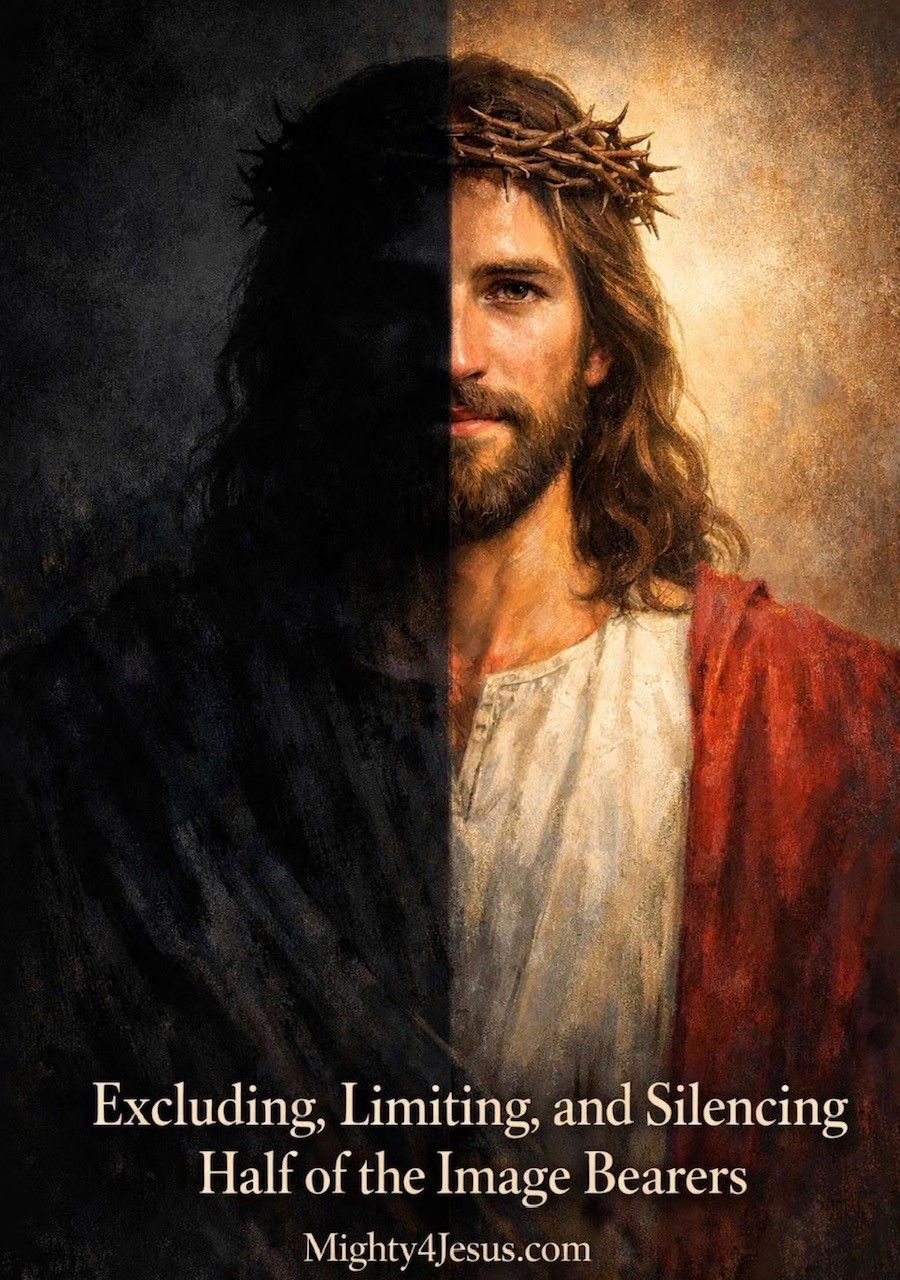
The purpose of this exercise is not to establish female superiority. It is to help us recognize what happens when interpretations and eisegesis are used to diminish an entire group of humans—half the Body of Christ.
Sometimes the best way to expose a double standard is simply to reverse it. From Genesis to Revelation, God consistently calls men and women to serve together, steward together, disciple together, and advance His Kingdom together as one Body under the lordship of Jesus Christ.
Jesus Himself settled the question of leadership when He said:
"You know that the rulers of the Gentiles lord it over them... It shall not be so among you. Whoever wants to become great among you must be your servant." (Matthew 20:25–26)
Leadership within the Body of Christ is never about who is in charge, because Jesus is the King of His Kingdom and the Head of His Church. Male and female together make up His Body. Jesus never established a hierarchy of men over women; He established a Kingdom where greatness is measured by humility, service, love, and Christlike character.
And just to be clear, Jesus didn't serve through His carpentry, bringing in a pay check. He served by setting the oppressed free.
The gospel does not exalt men over women—or women over men. It exalts Christ over us all. His authority and power flow through His entire Body, not merely half of it. Under His lordship, every believer is called, gifted, empowered, and commissioned to advance His Kingdom together.
Please share so others may know the truth that sets them free.
Be free to be Mighty for Jesus.
In freedom and might,
Jeannette
Facebook: Let My Women Go


Comments