Who Were the Oppressed Jesus Came to Set Free?


Understanding Jesus’ Liberation of Women
When Jesus stood in the synagogue and announced His mission, He declared:
“The Spirit of the Lord is upon me… He has sent me to preach good news to the poor, to proclaim release to the prisoners… to liberate the oppressed.” —Luke 4:18 CEB
This was not merely poetic language. It was a Kingdom mandate.
Jesus came for the poor, captive, marginalized, rejected, and oppressed. And among those living under deeply patriarchal control structures in the first-century Roman-Greek world were women.
To understand how radical Jesus’ treatment of women was, we need to understand the world into which He came.
Women in a Patriarchal World
The larger Roman-Greek culture was unmistakably patriarchal. Political and governmental power belonged overwhelmingly to men, and the Roman household historically centered authority in the male paterfamilias.
Greek philosophy also reinforced ideas of female inferiority. Centuries before Jesus, Aristotle taught that the male was naturally fitted to rule and the female to be ruled. Physical differences and greater male strength were among the reasons used to justify male rule. In other words, differences in the way men and women were physically created were used to justify differences in authority, roles, and status.
We still hear a similar inference today: God created men and women physically different; therefore, God created them for permanently different gender roles, positions of authority and submission.
But Genesis says something very different:
“God created humanity in God’s own image… male and female God created them.” —Genesis 1:27 CEB. God then gave both dominion over creation (Genesis 1:26–28). He did not give men dominion over women.
Physical strength does not determine spiritual authority, wisdom, Christlike character, intelligence, gifting, or leadership ability.
Patriarchy Was Present—But Was It God’s Design?
Patriarchy existed throughout much of the biblical world, but something being recorded in Scripture does not automatically make it God’s creation design.
Scripture records slavery, polygamy, oppression, warfare, abusive rulers, and numerous consequences of humanity’s fallen condition. Recording what people did is not the same as commanding what people should do.
In Genesis 1, male and female govern creation together. It is only after sin enters the world that we read, “he will rule over you” (Genesis 3:16). God was warning Eve, of what would now happen with those filled with pride and contempt.
Jesus then confronts power-over leadership:
“The ones who are considered the rulers by the Gentiles show off their authority over them… But that’s not the way it will be with you. —Mark 10:42–43 CEB
Not so with you.
Control, domination, and oppression reflect the dominion of darkness—not the Kingdom Jesus came to establish. Jesus came to liberate the oppressed, not sanctify their oppression.
His Kingdom operates through love, humility, service, freedom, and surrender to God—not one group exercising power and control over another. Jesus’ authority flows through His whole Body not just half.
Jesus Let Women Learn
Women generally did not have the same access as men to advanced formal religious education. Yet Jesus welcomed women as disciples. Mary of Bethany “sat at the Lord’s feet and listened to his message” (Luke 10:39 CEB). Sitting at a teacher’s feet was associated with being a disciple—a student learning from a teacher.
When Martha wanted Mary to return to serving, Jesus could have reinforced the traditional expectations placed upon women. He didn’t.
Instead, He said:
“Mary has chosen the better part. It won’t be taken away from her.” —Luke 10:42 CEB
Jesus refused to take learning and discipleship away from a woman.
We later find Paul instructing:
“A wife should learn…” —1 Timothy 2:11 CEB The Greek begins with the command: Let a woman learn. A passage frequently used to restrict women actually begins by commanding that women become learners.
Jesus Gave Women a Voice
Jesus publicly engaged women in serious theological conversations.
With the Samaritan woman, He discussed living water, eternal life, worship, and His identity as Messiah (John 4:7–26). She then went into her community and testified about Him.
“Many Samaritans in that city believed in Jesus because of the woman’s word when she testified.” —John 4:39 CEB. Her voice brought people to Christ.
Jesus also restored women who were suffering, marginalized, or publicly shamed. He healed the woman who had been bleeding for twelve years and called her “Daughter” (Mark 5:25–34). He healed the woman bent over for eighteen years and called her “a daughter of Abraham” (Luke 13:16).
Again and again, Jesus treated women as whole adult human beings before God—capable of learning, choosing, teaching, leading, and following Him.
Women Participated in Jesus’ Ministry
Women were not merely recipients of Jesus’ ministry. They participated in it and funded His ministry financially. Luke names Mary Magdalene, Joanna, and Susanna among the women traveling with Jesus and the Twelve and tells us there were “many others.”
Then Luke says:
“They provided for them out of their resources.” —Luke 8:3 CEB
Women were helping financially support Jesus’ ministry out of their own resources.
Women also remained near Him at the crucifixion, went to His tomb, witnessed the resurrection, and carried the news to others.
Then the risen Christ told Mary Magdalene:
“Go to my brothers and sisters and tell them…” —John 20:17 CEB
Jesus could have appeared first to Peter or entrusted the announcement first to one of the Twelve.
He chose Mary. A woman carried the greatest announcement in Christian history – the good news: Jesus is alive!
Men Do Not Represent Christ More Than Women
Another teaching used to establish gender hierarchy says the husband represents Christ, while the wife represents the Church.
But men are the Church too.
Scripture says:
“He is the head of the body, the church…” —Colossians 1:18
Christ is the Head. Men and women together are His Body.
A husband is therefore a member of Christ’s Body just as his wife is. He does not cease being part of the Church when he gets married and become a substitute Christ over his wife. And Genesis establishes that both male and female bear God's image (Genesis 1:27).
Men do not possess more of God's image. Women do not possess less.
Male and female both reflect and represent Him. Both are image-bearers. Both belong to Christ’s Body. Both are under one Head—Jesus Christ.
What Are We Saying About God?
This brings us to an important question.
If we claim women were created by God to occupy a permanently subordinate position because they were born female, we are not merely making a statement about women.
We are making a statement about God.
If God created one sex to possess authority over the other simply because of gender, then who established the gender hierarchy?
God did.
If women must remain under male authority regardless of their wisdom, gifting, calling, maturity, or empowerment by the Holy Spirit simply because they were born female, then we have attributed that discrimination to God Himself.
Do we realize what that implies about His character? Are we saying God designed gender prejudice and segregation, that He is unjust, and prefers one over the other?
Yet the Bible declares:
“take care what you do, for there is no perversion of justice with the Lord our God, or partiality, or taking bribes” – 2 Chronicles 19:7 NSRVUE
Physical difference does not establish hierarchy, especially in a spiritual Kingdom or in Christ.
We should be extremely careful not to take the prejudice, domination, and power structures of fallen humanity and attribute them to the character and design of God.
Why Put Women Back Under Men?
Since Jesus welcomed women as disciples, taught them theology, received their financial support, honored their testimony, restored their dignity, and commissioned them to proclaim His resurrection, why would His Church put women back beneath men?
Why would women filled with the same Holy Spirit need a man standing between themselves and Christ? Because that is actually called idolatry.
Why should controlling women become holy just because the prideful and arrogant choose kephalē—“head”—to be interpreted as “boss”?
Why should female subordination become biblical just because the prideful and arrogant want hupotassō—“submit”—to be interpreted as female obedience to male authority?
See my blog, “10 Reasons Why Kephalē Cannot Mean Leader,” for a closer examination of “head” and why it should not automatically be turned into a hierarchy of husbands over wives.
See my blog, “Only Wives Submit?” for a closer look at hupotassō, mutual submission, and why biblical submission should never be confused with inferiority, forced obedience, control, or abuse.
Jesus Came to Set the Oppressed Free
Look at the direction of Jesus’ ministry.
Women learned from Him.
Women sat at His feet as disciples.
Women followed Him.
Women financially supported His ministry.
Women testified about Him.
Women remained at the cross
.Women witnessed the empty tomb.
Women proclaimed His resurrection.
Then the Holy Spirit was poured out:
“Your sons and daughters will prophesy… Even upon my servants, men and women, I will pour out my Spirit.”
—Acts 2:17–18 CEB
And Paul declared:
“There is neither Jew nor Greek; there is neither slave nor free; nor is there male and female, for you are all one in Christ Jesus.” —Galatians 3:28 CEB
Throughout Scripture, God chose and empowered women as prophets, leaders, teachers, ministers, patrons, entrepreneurs, and builders of His Kingdom. Calling them merely “exceptions” diminishes the very women God chose to use and Scripture chose to remember. It is also an affront to God as Creator and loving Father.
The gospel does not exalt women over men or men over women.
It exalts Christ over us all.
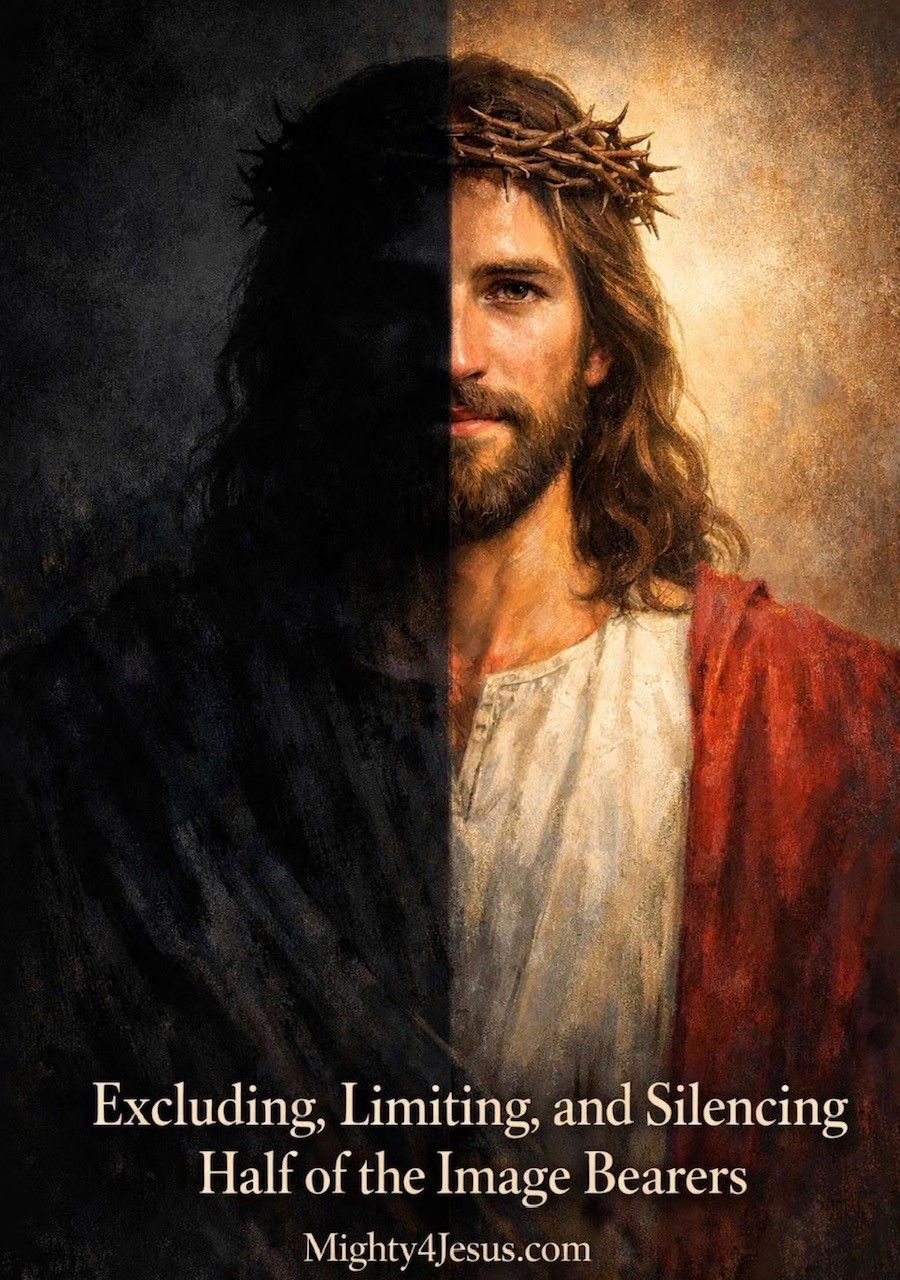
Male and female are image-bearers of their Creator, temples of the Holy Spirit, members of Christ’s Body, and participants in His Kingdom.
One Body. One Spirit. One Head—Christ.
“Where the Lord’s Spirit is, there is freedom.” —2 Corinthians 3:17 CEB
Free to hear Him.
Free to follow Him.
Free to learn.
Free to use their gifts in and outside the home.
Free to speak and teach where Holy Spirit leads.
Free to lead in the Church and home.
Free to be sent into whatever calling and assignment God has for them.
Free to be Mighty with Jesus
Please share so others may know the truth that sets free
In Freedom and Might,
Jeannette
Mighty4Jesus.com — for more resources, blogs, and books that set women free.
Facebook: Let My Women Go


Comments