Does Their Theology Reflect God's Character?

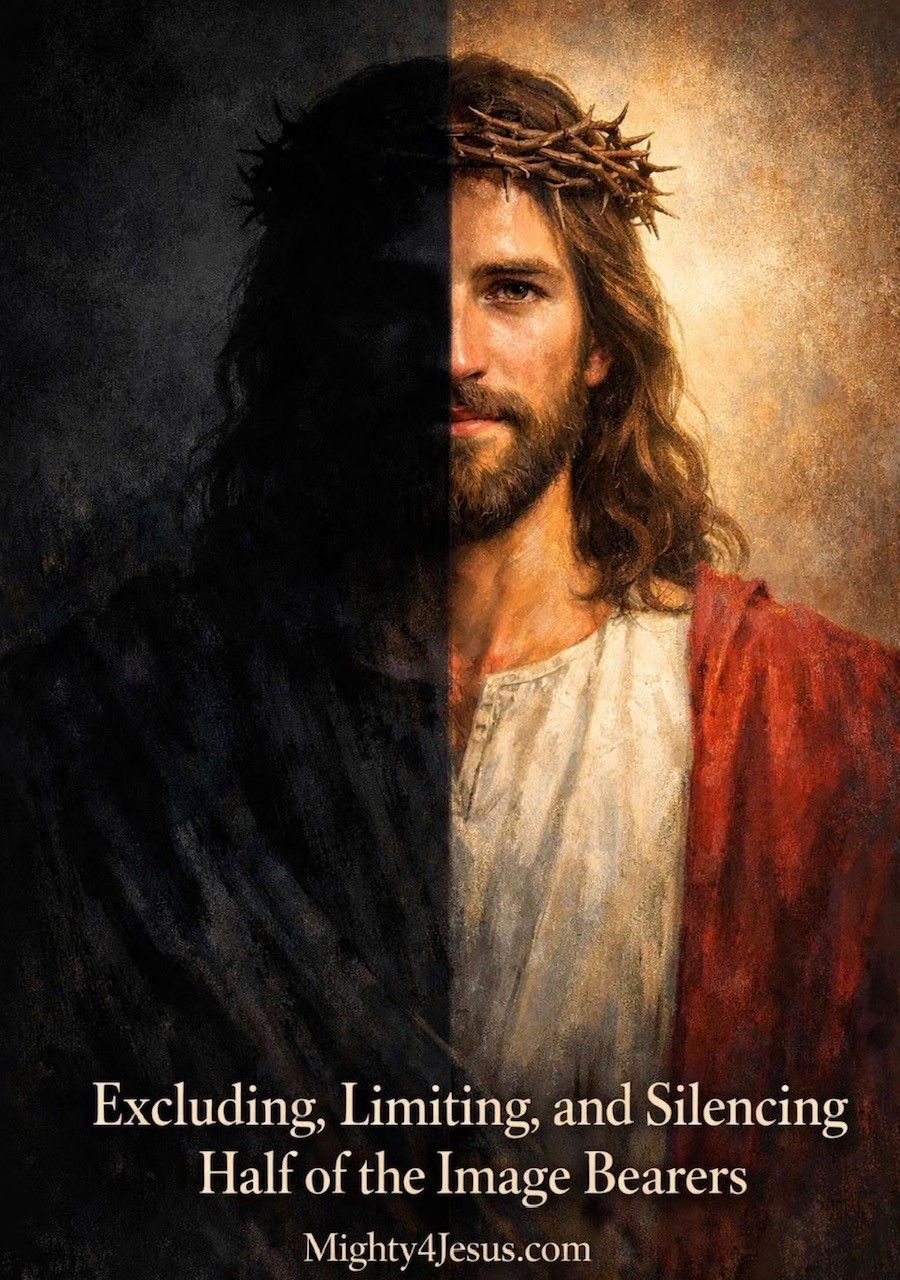
A Distorted Image of Jesus. What Our Treatment of God's Daughters Reveals About the God We Proclaim
One of the greatest consequences of silencing, excluding, limiting, or diminishing women in Christ is not only the harm done to women—it is the distortion of God's own character.
When leaders teach or imply that women are inherently less capable, less authoritative, or spiritually secondary to men, they are doing more than preserving a long-held tradition influenced by Greco-Roman culture. They are presenting a picture of God that Scripture itself does not reveal.
The Bible consistently declares that God is perfect, holy, just, and completely impartial.
"God shows no favoritism." — Acts 10:34
"He is the Rock, His works are perfect, and all His ways are just. A faithful God who does no wrong, upright and just is He." — Deuteronomy 32:4
Because God is perfectly good and just, He cannot create inferiority or “gender roles” that segregate and cause oppression as part of His design. Inferiority and gender prejudice does not exist within His nature; therefore, it cannot originate from Him.
Created in God's Image
From the very beginning, God created both male and female in His image.
"So God created mankind in His own image; in the image of God He created them; male and female He created them." — Genesis 1:27
Both men and women were created to reflect God's character. Together they received the same commission—to rule over the earth and steward creation (Genesis 1:26–28). Nothing in the creation account establishes one image bearer as having greater responsibility, authority, or importance than the other.
Some argue that because Adam was created before Eve, God established a permanent hierarchy of male authority. Yet Genesis never says this. Throughout Scripture, God repeatedly overturns human expectations. He often chose the last over the first. Abel instead of Cain. Isaac instead of Ishmael. Jacob instead of Esau. Joseph over his older brothers. David—the youngest of Jesse's sons—to become king. Ultimately, God sent His own Son, not as a conquering earthly ruler but as a humble servant.
Jesus Himself declared,
"The last will be first, and the first last." — Matthew 20:16
God's calling has never been determined by birth order, gender, age, or social status, but by His wisdom and purpose.
The assumption that "created order" establishes a permanent hierarchy is based on an interpretation of the text rather than an explicit statement within it. The creation account never says that being created first grants authority over another person.
What Does Scripture Say About Authority?
If God intended men to possess greater spiritual authority simply because they are male, we would expect Scripture to say so clearly.
It never does.
In fact, the only passage that directly speaks of exousia ("authority") within marriage gives it mutually to both spouses:
"The wife does not have authority (exousia) over her own body but yields it to her husband. Likewise, the husband does not have authority (exousia) over his own body but yields it to his wife." — 1 Corinthians 7:4
Likewise, Jesus gives exousia over the power of the enemy to His disciples (Luke 10:19), and those who believe in Him receive the exousia to become children of God (John 1:12).
Nowhere does Scripture explicitly state that men possess more exousia than women or that husbands possess greater spiritual authority than their wives.
To claim that half of humanity was created with permanent spiritual limitations is to attribute inequality and injustice to the God whose image they bear.
Scripture describes believers as one Body with one Head—Jesus Christ (Ephesians 1:22–23). Christ alone possesses ultimate authority over His Church.
The desire to elevate oneself above others did not originate with God—it originated with the enemy. Pride has always sought to exalt itself and grasp the honor, glory, and supreme authority that belong to Jesus Christ alone. Even the devil twisted Scripture in an attempt to achieve his own purposes. Whenever people pursue status, power, or control over others, they repeat that same pattern of self-exaltation. Rather than reflecting the humility of Christ, they imitate the pride that led to Satan's fall.
God's Kingdom was never designed to reflect the pride and self-centeredness of this world. It was designed to reflect the humility of Christ.
This discussion is therefore about far more than gender roles.
It is about whether our theology accurately reflects the character and image of God.
Jesus Reveals the Father
The true character of God is revealed perfectly in Jesus Christ.
If we want to know what God the Father is like, we need only look at God the Son.
Throughout His ministry, Jesus consistently restored dignity to women in a culture that marginalized them. He welcomed women as His disciples, taught them alongside men, defended them against religious hypocrisy, received their financial partnership in His ministry, entrusted them with proclaiming His resurrection, and honored them as full participants in the Kingdom of God.
Jesus never treated women as spiritually inferior, confined them to permanent gender-based limitations, or suggested they were less capable of advancing God's Kingdom. Instead, He continually elevated those whom society had pushed aside.
Because Jesus is "the image of the invisible God" (Colossians 1:15) and "the exact representation of His being" (Hebrews 1:3), His treatment of women reveals the Father's heart. Those who belong to Christ—both men and women—are called to reflect that same character.
The Holy Spirit Makes No Distinction
On the Day of Pentecost, Peter declared the fulfillment of Joel's prophecy:
"In the last days, God says, I will pour out My Spirit on all people. Your sons and daughters will prophesy." — Acts 2:17
The Holy Spirit distributes gifts, ministries, and callings according to His will—not according to gender, status, or human preference.
Throughout Scripture, God entrusted women with prophecy, leadership, teaching, discipleship, evangelism, financial partnership in ministry, entrepreneurship, and the oversight of house churches. His actions consistently reveal His character.
God does not call, gift, empower, and fill women with His Spirit only to permanently restrict them from serving according to that calling whether married or single.
If God entrusts women with His Spirit and His mission, who are we to withhold opportunities that He Himself has given?
Jesus also challenged worldly models of leadership, saying:
"You know that the rulers of the Gentiles lord it over them... Not so with you." — Matthew 20:25–26
In God's Kingdom, greatness is never measured by power, position, or maleness, but by humility, love, and service.
Throughout history, the church has had to confront teachings that elevated one group above another. We rightly reject doctrines of racial superiority because they contradict the gospel and the truth that God shows no favoritism (Acts 10:34). Yet many continue to teach that God grants men positions of spiritual authority and leadership that He permanently withholds from women simply because of their gender.
The gospel rejects every form of superiority rooted in the flesh. In Christ, our identity is found not in race, social status, or gender, but in Him. Any theology that elevates one group while restricting another because of an unchangeable human characteristic should be carefully examined in light of God's revealed character.
The Real Question
The Kingdom of God is not built on superiority, hierarchy, segregation, or discrimination. It is built on Christ alone, who is the Head of His Church, working through His people to push back darkness, set captives free, serve one another in humility, love, and faithfulness according to the gifts He has given.
Ultimately, this conversation is about far more than women.
It is about whether the Church accurately represents the God it proclaims.
When the world looks at the church, what does it see? Does it see a God who gives greater authority, responsibility, and opportunity to men while limiting women because of their gender? Does it see one group consistently elevated while another is expected to remain in a secondary role?
If that is the picture we present, then—apart from the prideful and arrogant—who would want to be part of such a Kingdom? And if that kind of system appeals only to those seeking superiority, power, or control, we must ask ourselves: Which kingdom are we really representing?
But this is not the Kingdom Jesus came to establish. Jesus came "to proclaim freedom for the prisoners... and to set the oppressed free" (Luke 4:18). He broke down the barriers that divided people and invited all who believe to participate in His mission according to the gifts and calling He gives.
The Father's heart has never been to elevate one image bearer over another, but to unite His children under one Head—Jesus Christ.
May we faithfully reflect His heart, His justice, and His Kingdom so that the world sees not human superiority, but the transforming love of Christ.
If this article encouraged you, please consider sharing it so others may discover the truth that sets people free.
To learn more about God's design for His Kingdom on earth and His image bearers, explore my books Life in God's Kingdom: How to Manifest Heaven on Earth
For a Healthy Marriage get my book: Before the Ring and Beyond, the Ultimate Key to a Healthy Marriage. Also used as a great Marriage Preparation tool.
Or my book Let My Women Go! Setting Women Free From Oppression and Abuse - Expanded Edition coming soon!
Be free to be mighty for Jesus.
In freedom and might,
Jeannette


Comments