Wives Only Submit?


What the Original Greek Actually Says
Few teachings have shaped Christian marriage more than the familiar phrase:
"Wives, submit to your husbands."
For many Christians, these words have been understood to mean that husbands hold authority while wives occupy a subordinate position. But before building an entire doctrine on one English phrase, we should ask an important question:
Is that what Paul actually wrote in Greek?
The answer is more nuanced—and far more beautiful.
The Verse Almost Everyone Starts With... But Paul Didn't
Most discussions begin with Ephesians 5:22:
"Wives, submit yourselves to your own husbands..."
But Paul actually begins one verse earlier:
"Submit to one another out of reverence for Christ." (Ephesians 5:21)
This is the controlling command for the entire passage.
In the earliest Greek manuscripts, verse 22 does not contain its own verb. Paul simply writes:
"Wives... to your own husbands..."
The verb submit is carried over directly from verse 21.
A first-century Greek reader would naturally understand it as one continuous sentence:
"Submitting to one another... wives to your own husbands... husbands, love your wives..."
Paul did not begin with wives.
He began with everyone.
What Does Hupotassō Actually Mean?
The Greek word translated submit is hupotassō (ὑποτάσσω).
Many people assume it means obey, be under someone's authority, or accept a lower rank.
But that is not what the word necessarily meant in first-century Greek.
Originally, hupotassō was a military term meaning to arrange or coordinate under a common purpose. Outside military contexts, it developed a broader meaning of voluntarily yielding, cooperating, supporting one another, or placing oneself alongside another for the good of the relationship.
It describes willing cooperation—not forced obedience.
It is never presented as proof that one person possesses greater authority than another.
Paul Knew the Difference
This is an important point.
Paul knew the Greek language exceptionally well. If he had wanted to teach that husbands were rulers over their wives or possessed greater authority, he had several Greek words available that communicated those ideas.
He could have used exousia ("authority"), archōn ("ruler"), archē ("rule" or "government"), or even katakurieuō, the word Jesus used for "lording it over" others (Matthew 20:25).
But Paul chose none of those words.
Instead, he chose hupotassō—a word that, in this context, reflects willing cooperation, humility, and mutual support.
His word choice was intentional.
Everything "In Christ" Is Mutual
One of Paul's favorite expressions is "in Christ."
Life in Christ consistently replaces power with service and pride with humility.
Throughout the New Testament we repeatedly find mutual language:
love one another
serve one another
forgive one another
encourage one another
bear one another's burdens
submit to one another
There are well over one hundred "one another" commands throughout the New Testament. This is the culture of God's Kingdom. Mutuality is not a modern idea—it is the atmosphere of life in Christ.
So when Paul tells wives to hupotassō their husbands, he is not suddenly abandoning everything he has already taught about mutual Christian relationships. He is applying that same principle of humility and mutual love within marriage.
Ephesians 5:24 Is Not About Rank
Verse 24 says:
"As the church submits to Christ, so also wives should submit to their husbands in everything."
This verse is often treated as though Paul suddenly introduces a chain of command.
But notice what Paul does not say.
He never tells husbands to rule.
He never commands husbands to exercise authority.
He never uses the Greek words for ruler, governor, master, or exousia ("authority").
Instead, he immediately tells husbands:
"Love your wives, just as Christ loved the church and gave Himself up for her." (Ephesians 5:25)
Christ's relationship with the church is not built on domination but on sacrificial love. Likewise, the church's submission to Christ is not forced obedience to a tyrant. It is the joyful response of people who completely trust the One who gave His life for them.
Paul is describing the quality of the relationship—not establishing a hierarchy.
What About "The Wife Must Respect Her Husband"?
Many English translations read, "the wife must respect her husband" (Ephesians 5:33). But the Greek is more nuanced.
Paul does not use the straightforward imperative that would simply say, "Respect your husband!" Instead, he uses a purpose clause introduced by the Greek word hina (ἵνα), meaning "so that," "in order that," or "that." Rather than issuing a direct command, Paul points to the intended outcome of a Christ-centered marriage.
This fits the character of Jesus.
Throughout the Gospels, He never forces love, honor, or obedience. He invites. He calls. He gives people the freedom to respond. Love, respect, and honor cannot be coerced—they must be freely given. If Christ Himself does not demand love by force, no husband has the biblical right to demand respect or submission from his wife.
Respect that is demanded is no longer respect—it is compliance born out of fear or obligation. Genuine honor, like genuine love, can only be freely given.
In the same way that hupotassō describes a voluntary posture rather than forced subordination, respect within marriage grows naturally from a relationship marked by sacrificial love, trust, humility, and mutual honor. It is never something one spouse has the right to demand from the other.
Jesus Himself stands at the door and knocks (Revelation 3:20). He does not force His way into relationship with anyone. If the Lord of all creation refuses to coerce people into loving or following Him, neither should a husband believe he has the right to demand submission or respect from his wife.
Marriage Reflects Christ
Before sin entered the world, God declared:
"Let them rule..." (Genesis 1:26–28)
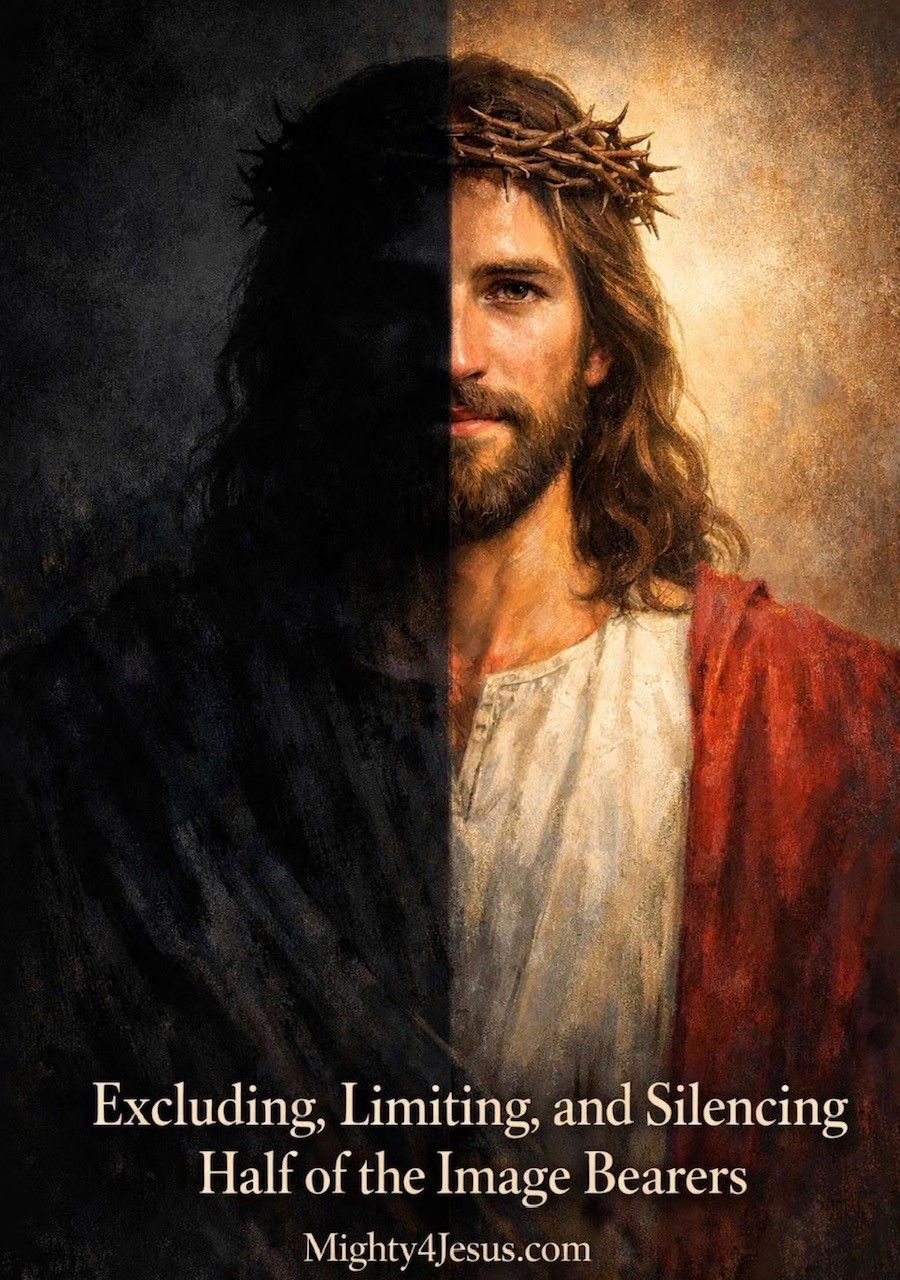
Male and female were both created in God's image, both received the same commission, and both were entrusted with the shared responsibility of stewarding creation.
Nothing in Eden describes the man ruling the woman or being given greater authority because he was created first.
The popular "created order" argument assumes that being created first automatically establishes leadership. Yet throughout Scripture, God repeatedly overturns that assumption. He often chooses the last: the younger, the later-born, or the unexpected person to accomplish His purposes—Abel over Cain, Isaac over Ishmael, Jacob over Esau, Joseph over his older brothers, Ephraim over Manasseh, David over his older brothers, and many others.
Being first is never presented as God's principle for leadership.
After the Fall came the tragic prediction:
"He will rule over you." (Genesis 3:16)
This was not God's command or His design. It was a description of the broken relationships that sin would produce.
Jesus came to reverse the effects of Adam's rebellion and restore what sin had broken—not preserve one of its consequences.
In Christ, relationships are marked by mutual love, humility, service, and partnership, reflecting God's original design from the beginning.
The Whole Picture
When Ephesians 5 is read in its original language and within its full context, Paul's message becomes remarkably consistent.
Believers submit to one another.
Husbands sacrificially love their wives as Christ loved the church, creating the kind of relationship in which wives would willingly honor, respect, and support their husbands.
Neither spouse is instructed to rule, dominate, or exercise authority over the other. Nowhere in the New Testament does the original Greek teach that husbands possess more exousia ("authority") than their wives or are given authority over them.
That is the heart of hupotassō—not forced subordination, hierarchy, or male authority, but voluntary humility, mutual honor, and loving collaboration that characterize everyone who lives in Christ.
When we read Paul's words through the lens of Jesus' life, teachings, and the whole counsel of Scripture, we discover that biblical marriage is not about power or control. It is about two image-bearers, equally created in God's image, equally filled with the Holy Spirit, and freely choosing to love, serve, honor, and support one another as one Body under one Lord.
That is the beauty of God's design.
Not hierarchy.
Not domination.
But Christ.
please share so others may know the truth that sets free
Be free to be mighty for Jesus.
In freedom and might,
Jeannette


Comments